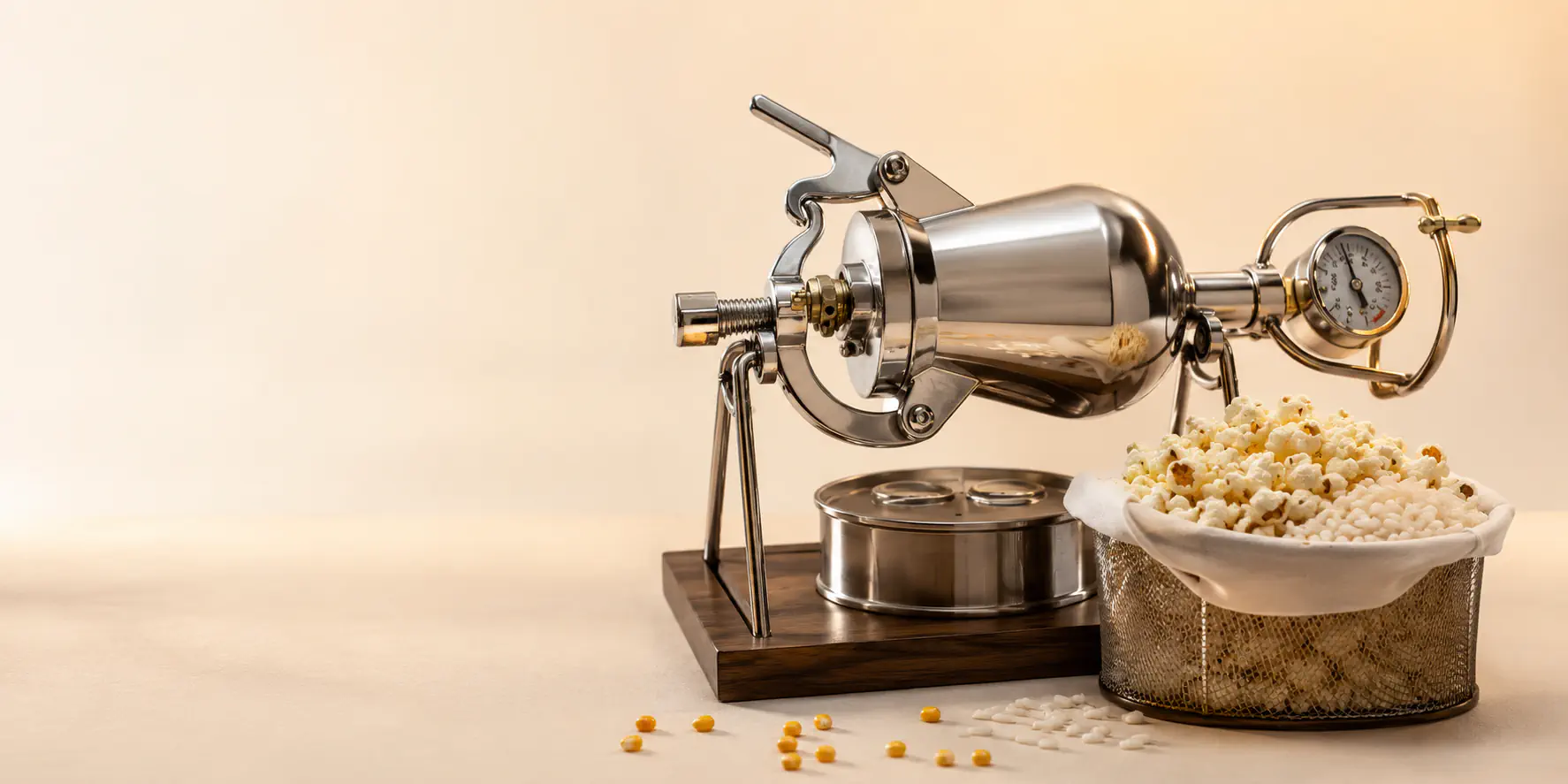
The Chinese popcorn cannon is more tool than kitchen appliance
It looks like a small piece of lab equipment, works with pressure instead of a fan, and opens with a bang: this hand-cranked popcorn machine is fascinating, but it's no casual everyday popper.
🧭 Traditional puffing principle
📈 Pressure vessel with a gauge
🔥 For open flame/burner
Pressure instead of a fan
What makes the popcorn cannon special
0 lever
Releases the pressure vessel instantly and creates the signature bang
0 parts
Are especially important: an easy-to-read pressure gauge and a reliable safety valve
0
Early photo evidence of a portable puffing machine in China
0 person
Should operate the machine with full attention, not as a side task
Featured Product
Our Top Pick
350ml Chinese Popcorn Maker, Chinese Popcorn Cannon Machine, High Pressure Popcorn Popper, Popcorn Machine for Family Party Fun, Upgraded Bamboo Base and Bracket(with Gift Box&2 Bags)
At [Qoxvyn], we believe that home is the stage of life, and every product should be a perfect combination of practicality and aesthetics. We are committed to creating unique home products for users, so that consumers can be inspired and use our products every day.
【High Quality Manual Popcorn Machine】This Chinese popcorn machine is made of high quality, it is very durable, easy to use.It is portable, allowing you to make delicious food anytime, anywhere
【How to Use】Considering safe transportation, we are sorry that we cannot provide fuel. Please prepare safe mineral oil or 95% pure alcohol as fuel.For specific operation methods, please refer to the video on the purchase page or the instruction manual
【Excellent Security】The retro pressure popcorn maker has active & passive safety valve design, dual safety valves provide you with safety protection.In most cases, we only need to check whether the active safety valve is tightened before heating and refer to the pressure gauge for heating
* Affiliate link: If you buy through it, we earn a small commission. The price stays the same for you.
In short: The Chinese popcorn cannon is a small grain-puffing gun: corn, rice, or other grains are heated inside a sealed stainless-steel vessel and puff instantly when it's opened quickly. Exciting for tech fans and show moments, but noticeably more demanding than hot-air, UFO, or movie-theater popcorn machines because of the pressure, heat, and bang.
Why it's often known as the Chinese popcorn machine
This machine belongs to the family of so-called puffing guns: sealed pressure vessels that puff grain through heat, pressure, and a sudden release. In China, this design became a street-market spectacle mainly in the 1980s and 1990s. The bang was part of the show, but originally it wasn't just about popcorn - it was also about puffed rice and other grains.
From puffed rice to popcorn cannon
1901
Alexander P. Anderson experiments with heated starch, laying the technical groundwork for industrially puffed grain.
1938
Photos from Beidaihe already show a portable puffing machine in China - though the exact origin of this design remains undocumented.
1980s
Mobile street vendors with these machines become common again in mainland China, puffing corn and rice right in front of customers.
Today
Small stainless-steel models with a gauge, hand crank, and safety/pressure-relief valves are sold as mini popcorn cannons for home use.
✨
The bang isn't a gimmick
In a popcorn cannon, the grain isn't heated kernel by kernel like in a pot - it's prepared inside a sealed pressure chamber. When it's opened, the pressure drops instantly; water inside the kernel flashes into steam and the starch expands. That's why rice, millet, beans, and other suitable grains can be puffed too, not just corn - though the result depends heavily on moisture, pressure point, and handling.
How the hand-cranked popcorn machine works
The pressure vessel is filled with a small amount of grain and sealed tight. It then sits over a heat source while the crank rotates the vessel. This spreads the heat more evenly so individual kernels don't scorch right away. The gauge shows the pressure; once the target range is reached, the latch is opened from a safe distance and the contents shoot into a catch bag or container.
That exact process is what makes it appealing - and risky. This isn't a machine you let run in the background. Whoever operates it has to keep constant watch on pressure, heat, the latch, and the ejection direction.
What size makes sense?
With Chinese popcorn machines, bigger isn't automatically better. Small pressure vessels are more show-and-experiment devices for modest amounts, while larger models need more heat, more space, and more routine. For home use, a small to medium vessel is usually the more sensible choice: it heats more predictably, stays easier to handle, and a failed batch is less frustrating.
Flavor: different from movie-theater popcorn
A Chinese popcorn cannon doesn't automatically give you buttery movie-theater popcorn. Because the kernels puff mainly from the pressure release, the dry grain flavor is more front and center. Sweetness, salt, butter, or spices are usually added after puffing. If you want caramel to melt right onto the kernel, you're better off with a classic kettle popcorn machine or a stovetop pot.
Who is a popcorn cannon like this worth it for?
It's worth it mainly for tech fans, food nerds, collectors, and anyone planning a little demonstration. As an everyday appliance, it's less practical than almost any other popcorn machine: it needs an external heat source, works under high pressure, is loud when opened, and demands more safety discipline. If you just want quick popcorn for movie night, you'll be happier with a hot-air, UFO hot-plate, or movie-theater kettle machine.
What to look for when buying
Material, latch, gauge, and valves matter more than the marketing copy. Stainless steel is a good sign, but only reassuring if the build quality, sealing surfaces, and screw points look clean. A clearly readable gauge, a safety valve, and a pressure-relief valve are must-haves. Also check that the instructions, included parts, replacement gaskets, and return policy are clearly stated - product names, sellers, and included accessories change frequently on generic import listings.
Cleaning and care
After it cools down, the pressure vessel, gasket, ejection opening, and gauge connection should be kept free of grain residue. The small channel to the pressure gauge in particular must not clog, or the reading becomes useless. Don't scrub the sealing surfaces, avoid harsh cleaners, and don't store it sealed with leftover moisture inside.
If the pressure principle excites you, the popcorn cannon is a fascinating experimental appliance - not the most convenient snack maker.
🎭
Show & theme nights
For a controlled demonstration, the bang effect is impressive. Plan for distance, a catch container, and hearing protection.
🍚
Puffed-rice curious
This machine is interesting if you want to try rice or other grains, not just corn.
🛡️
Important: not a toy, not for kids
This design uses a sealed, heated pressure vessel. Only use it per the manufacturer's instructions, outdoors or in a very well-controlled environment, on stable footing, at a distance from the ejection side, and with no kids nearby. If you smell burning, notice a leak, see a blocked gauge, or the pressure situation is unclear, stop heating and don't improvise.
Passend dazu
Unsere Empfehlungen
Hand Popcorn Maker Popcorn Machine Hand Popcorn Cannon 304 Stainless Steel Popcorn Machine Home Retro High Pressure Popcorn Maker, Puffed Rice Maker for Home Party (260ml)
This multifunctional popcorn maker will evenly heat the corn seeds to provide you with a perfectly popped snack. You can customize your popcorn flavor by adding a variety of tasty toppings such as butter, sugar, ketchup, cheese, cocoa powder, salt and your favorite spices. Inspired by the style of earlier times, this mini hand-cranked popcorn maker has a more unique style than modern popcorn makers.
Product Name: pressure popcorn make
Material: 304 stainless steel
Color:Silver
Capacity:260ml, 300ml, 400ml, 520ml,
260ml Size: Length 27cm
300ml Size: Length 27cm
400ml Size: Length 30cm
520ml Size: Length 33cm
Operation mode: hand Heating
Chinese Popcorn Maker, 260ML Popcorn Machine, Popcorn Cannon | High Pressure Popcorn Popper with Pressure Relief Valve, Wooden Base,Stainless Steel,Hand Cranked,for Home Party, Large 260ml
Hand Popcorn Machine, 100ml High Pressure Popcorn Maker, Chinese Traditional Old-Fashioned Pop Corn Machine, Stainless Steel Mini Hand Cannon Food Amplifier
Feature High Precision Mini hand popcorn machine is equipped with a precision pressure gauge. You can observe the pressure to find out real-time conditions and temperature to make timely adjustments. Great Stability Traditional vintage mini popcorn maker is made of stainless steel and thickened precision-forged lugs, so it is extremely stable. It will not shake easily during high-speed operation. Fine Polishing Popcorn machine's whole body is polished with a high-temperature polishing treatment, so the surface is smooth and shiny. It is a finely crafted handicraft. Easy to Use This hand-cranked popcorn machine is easy to assemble and use, easy to clean. You only need to wipe the surface with a towel. An Ideal Gift Its retro style is easy to evoke memories of childhood, so it is a great choice as a gift for your family or friends. Application It can be used for popcorn making. It can also be used as a piece of home decoration. The retro look can add a more vintage feeling to your room. Specification Material: Stainless Steel Color: Silver Capacity: 80-140 Ordinary Corn Kernels Length: Approx 20cm/7.9in Diameter: Approx 5.8cm/2.3in Weight: Approx 1.25kg/ 2.8lb Package Weight: 25.5x12x15cm/ 10x4.7x5.9in Package Included 1* Mini Hand Popcorn Machine 1* Accessory Notes: Although this product can make popcorn, it is designed as a professional mini-model handle, which requires very professional operation skills. Normal people and non-professionals may be dangerous due to improper operation.
The mini popcorn cannons discussed here are usually not electric. They're turned by a hand crank and heated with an external heat source.
Why does the popcorn cannon make a bang?
The bang happens when the heated pressure vessel is opened quickly. The pressure drops instantly and the grain puffs open explosively.
Can you only make corn with it?
Many sellers also advertise these machines for rice and other grains. Whether that works cleanly depends on the grain type, moisture, amount, pressure, and handling.
Is the popcorn cannon suitable for kids?
No. Because of the pressure, heat, open heating mode, and loud opening bang, it's not a kid-friendly appliance. Hot-air or microwave poppers are a much better fit for families.
Does popcorn from it taste like movie-theater popcorn?
Not automatically. The machine puffs the kernel dry, driven by pressure; butter, salt, sugar, or spices are usually added afterward. For classic movie-theater flavor, a kettle machine is the more natural choice.
Want the show, but with less risk and more everyday practicality?
We only use technically necessary cookies. With your permission, we also use Google Analytics to improve the site - you can change your choice anytime. See our privacy policy for details, including your California privacy rights.