130 psi of pressure in the kernel
Before a corn kernel bursts, steam pressure inside it builds to around 130 psi - roughly four times the pressure in a car tire.

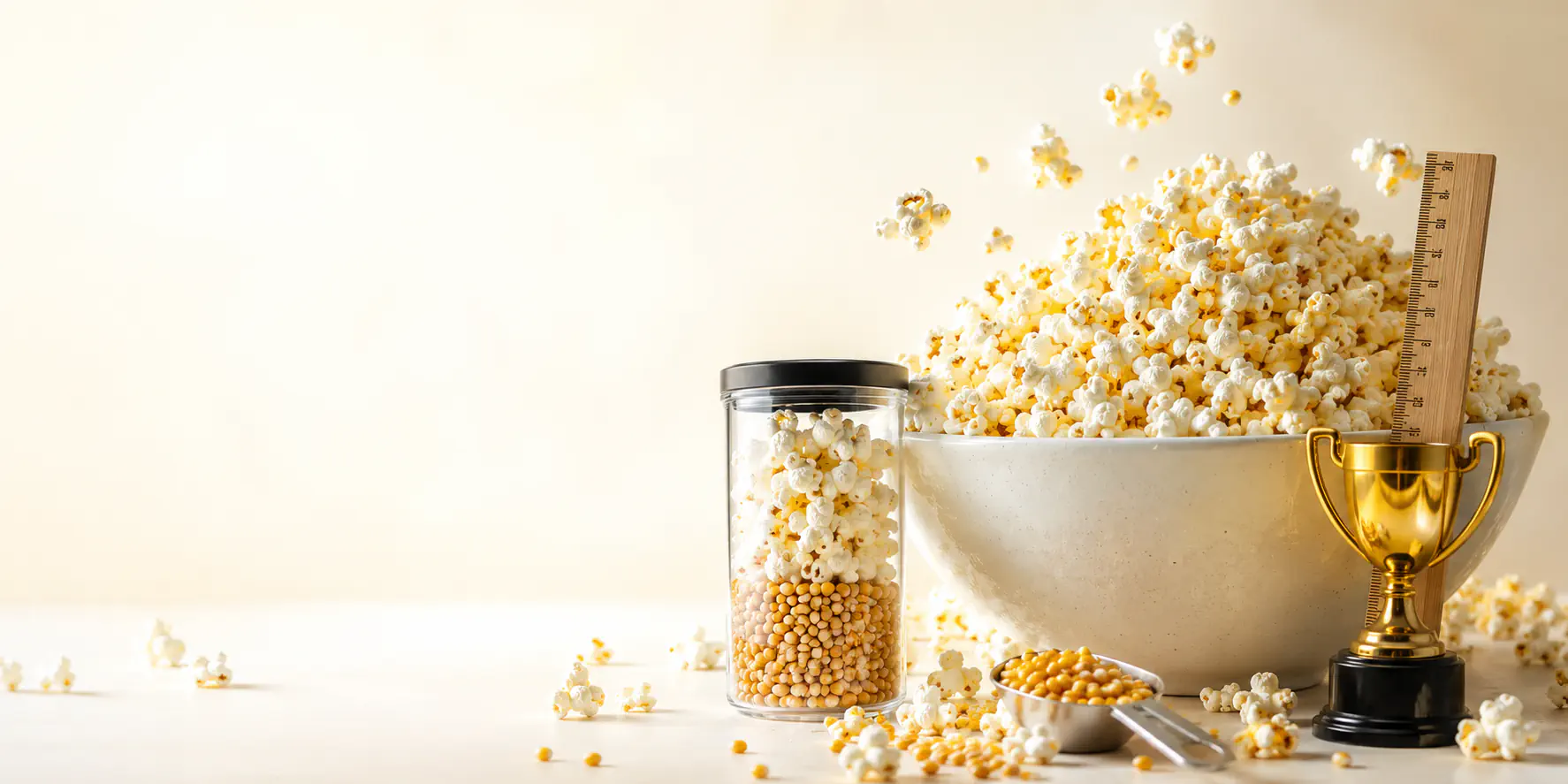
Why does corn pop at 130 psi? How old is the oldest find? And what's the world record? Here's the collection of popcorn knowledge for show-offs and the curious alike.
In short: Popcorn is packed with astonishing details: pressure inside the kernel builds to around 130 psi before it explodes at about 356°F and expands to many times its size. The oldest finds are thousands of years old, and popcorn festivals, records, and oddities pop up all around the globe.
Next time the bowl gets passed around at movie night, casually mention that pressure inside every kernel hits about 130 psi before it bursts - more than four times what's in a car tire. Guaranteed at least one person pauses to look thoughtfully at the popcorn in their hand.
Filter by topic or just browse. Every card is a fact worth remembering and passing along.
Before a corn kernel bursts, steam pressure inside it builds to around 130 psi - roughly four times the pressure in a car tire.
Only at about 356°F does the water inside the kernel flash into steam. Below that, simply nothing happens - the kernel just stays hard.
A corn kernel expands to up to 40 times its original volume when it pops.
Corn only pops reliably at a moisture content around 14 percent. Too dry, and there's not enough steam; too moist, and it turns chewy.
A kernel launches several feet per second when it pops - accompanied by the signature pop sound, which comes from the escaping steam.
Only popping corn has a hull hard and dense enough to hold that pressure long enough. Other corn varieties just let the steam escape.
Archaeological finds of popcorn in the Americas are dated to several thousand years old - one of the oldest known snacks in human history.
Charles Cretors built the first mobile, steam-powered popcorn machine in Chicago in 1885 - the birth of popcorn as a street snack.
Of all times, popcorn became a movie-theater snack during the Great Depression: it was cheap, and theater owners discovered the huge profit margin.
Microwave popcorn made the snack a mass-market living-room staple for good starting in the 1980s - ready anytime, no pot required.
Corn was domesticated in Mesoamerica long before many other farming techniques even existed. Popping corn is one of its oldest forms.
Teams keep building giant popcorn balls and sculptures weighing hundreds of pounds - records that get broken again and again.
Record attempts have filled gigantic containers with many cubic yards of popcorn - more than an entire theater sells in a season.
Popcorn speed contests are about eating or catching as much popcorn hands-free as possible in the shortest time - trickier than it sounds.
There are records for catching a thrown piece of popcorn in your mouth from astonishing distances - a popular stunt for videos and shows.
Several US towns hold annual popcorn festivals with parades, contests, and tons of freshly popped corn.
The US has an unofficial National Popcorn Day - one day a year dedicated entirely to the snack.
Popcorn strung on thread is a traditional North American Christmas tree decoration - edible garlands instead of tinsel.
There are purple, red, and black popping corn kernels - but no matter how dark the kernel, the popcorn always turns creamy white, because the color only lives in the hull.
The sound doesn't come from the burst itself - it comes from steam escaping under pressure, a tiny burst of vapor per kernel.
Popcorn pops either as winged butterfly or round mushroom - the same plant, just bred deliberately for one shape or the other.
Popcorn is basically a tiny pressure cooker. Inside every kernel sits moisture, sealed in by an unusually hard hull. When heated, that water turns to steam, and pressure climbs to around 130 psi - until the hull suddenly gives way and the starch inside foams into the familiar white mass.
This mechanism only works with popping corn. Every other corn variety has a more permeable hull that lets steam escape before enough pressure can build. That's why sweet corn or feed corn won't pop, no matter how hot you get it.
Popcorn has been with humanity for thousands of years. In the Americas, it's provably ancient, known long before Europeans arrived. But it made the leap to a modern mass-market snack thanks to two inventions: Charles Cretors' mobile popcorn machine in 1885, and, nearly a century later, microwave popcorn.
The decisive cultural moment was the movie theater of the 1930s. During the Great Depression, popcorn was one of the few affordable pleasures around - and theater owners quickly noticed they made more from it than from ticket sales.
Popcorn lends itself perfectly to spectacular records: the largest popcorn ball, the largest serving ever made, the longest mouth-caught throw. Since these records keep getting broken, we're deliberately skipping specific numbers that would quickly go stale - the fascinating takeaway stays the same either way: something this small and cheap can produce astonishing results.
If you want the current standing of a specific record, the official record-keeping organizations that document and date these feats are the most reliable source.

This fun popcorn maker allows you to make a single 30g (1 oz) portion in one go, so it should put an end to arguments over who has eaten more than their fair share on movie nights. What's more, it's made from high-quality, heat-resistant silicone, so it won't melt with the high temperatures in the microwave when popping corn. It has an integrated measuring guide in the base and lid flaps that conveniently open when the popped corn is done and reaches the top of the maker. With no oil or butter required, it's a great way to make the perfect healthy snack. Sold as a pack of 2 popcorn makers.
In Stock

Is the kettle difficult to clean after use? I've had issues with other machines being hard to reach inside? Not at all! We designed this machine with a detachable, food-grade stainless steel pot specifically to make cleaning a breeze. You can easily unhook and remove the kettle completely from the machine to wash it in your sink (as shown in our manual). Can the popcorn machine be separated from the cart to use on a countertop or table? Yes, absolutely! This is a 2-in-1 design. The main popcorn maker unit is completely detachable from the rolling cart base. You can easily lift it off to place it directly on your kitchen counter, a home theater stand, or a party table. How much popcorn can it make in one batch? Is it enough for a family movie night or a small party? It's perfect for gatherings! This machine features a large 10-ounce kettle that can produce up to 32 cups of theater-quality popcorn per batch in just about 8 minutes. It boasts a 99% high popping rate, meaning very few unpopped kernels. Does the cart have space to store popcorn supplies, and is it easy to move around? Yes! The cart features a built-in, storage cabinet at the base, which is perfect for keeping your popcorn cooking oils, seasonings, and serving bags neatly organized and out of sight. It also comes with cart handle, making it very easy to transport Is it complicated to operate for a beginner? What accessories are included in the box? It is very user-friendly with a simple one-click switch operation. Just follow 3 simple steps: turn it on, pour in your corn, oil, and sugar/salt, and wait for the magic!
Only 8 left in stock - order soon.

Amish Country Popcorn produces over 13 varieties of popcorn that are home grown in the rolling cornfields of Berne, Indiana. All of of our popcorn is non-GMO, gluten and preservative free. At Amish Country Popcorn, we are committed to keeping popcorn simple and natural. Amish Country Popcorn offers over 13 different varieties of kernels. All of our kernels are available in a variety of sizes and combinations ranging from 4 ounce to 25 lb bags. All of our kernels are non-GMO, gluten, and preservative free. Amish Country Popcorn never grows genetically modified popcorn and provides our customers with the best tasting snack in the country. All our popcorns are un-popped, so you don't have to worry about a treat that has been coated in sodium and chemical preservatives.
In Stock

Ornamental Indian corn, scientifically known as Zea mays, is a vibrant and decorative variety of maize that has been cultivated for centuries. Often referred to by nicknames such as "calico corn," "flint corn," or simply "Indian corn," this plant is prized for its multicolored kernels, which can display striking shades of red, blue, yellow, white, and purple. Unlike sweet corn, which is harvested for its sugary taste, ornamental Indian corn is typically grown for aesthetic purposes, such as fall decorations, crafts, or even as a heritage crop to preserve traditional varieties. Native to the Americas, it was a staple in Indigenous cultures long before European settlers arrived, and its diverse colors are a result of selective breeding over generations. Planting ornamental Indian corn from seed is a straightforward process that requires some basic preparation. Start by selecting a sunny location with well-drained, fertile soil, as corn thrives in full sunlight and nutrient-rich conditions. Sow the seeds in late spring, after the last frost, when soil temperatures reach at least 60°F (15°C). Plant the seeds about 1-2 inches deep and 8-12 inches apart in rows spaced 2-3 feet apart to allow for proper growth and air circulation. Water consistently to keep the soil moist but not waterlogged, especially during germination and early growth stages. With a growing season of 90-120 days, depending on the variety, you’ll have a stunning harvest of colorful ears by autumn, perfect for display or grinding into cornmeal if desired.
In Stock

Our journey began with a simple belief: the warmth of a fire and the joy of delicious food create unforgettable moments of relaxation and connection. We aim to make this experience flawless. Our mission is to provide practical, high-quality cooking and grilling tools that empower our customers to effortlessly enjoy the gatherings with family and friends, celebrating the magic of flame and flavor together. Crafted From Coating-Free 304 Stainless Steel, Non-Toxic, Securely Make Healthy Popcorn Over An Open Fire Long & Detachable Handle, Nylon Bag Included for Easy Storage and Carry . When using on a gas stove, place a sheet of aluminum foil between the mesh lid and the pot to prevent oil from splattering onto the stove.
In Stock
* Affiliate link: If you buy through it, we earn a small commission. The price stays the same for you.